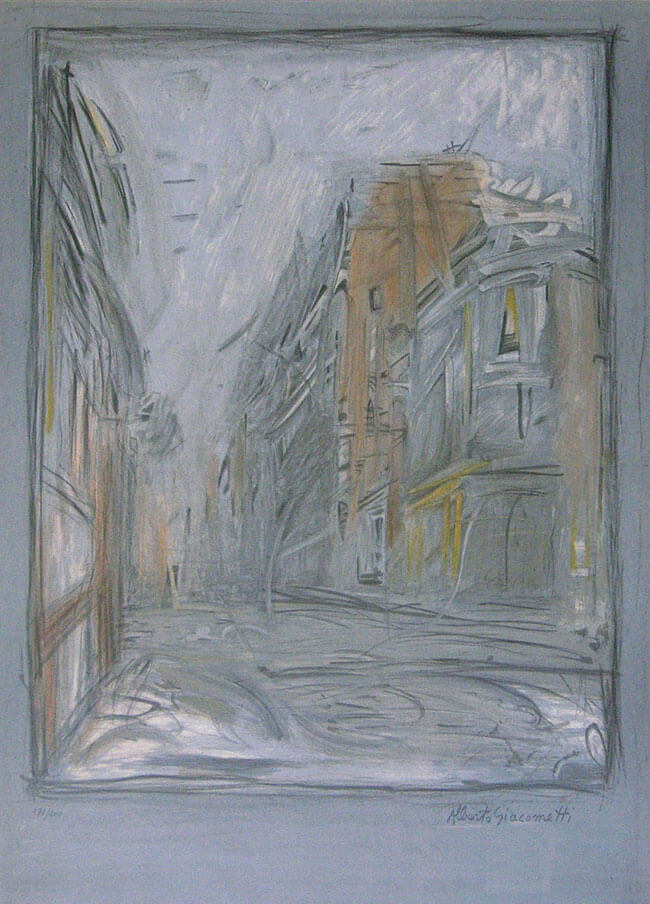

Alberto Giacometti, Rue d'Alesia |
|
| Artist: | Alberto Giacometti (1901 - 1966) |
|---|---|
| Title: | Rue d'Alesia |
| Medium: | Orig Color Lithograph |
| Image Size: | 26 3/4 in x 21 in (68 cm x 53.3 cm) |
| Sheet Size: | 26 3/4 in x 21 in (68 cm x 53.3 cm) |
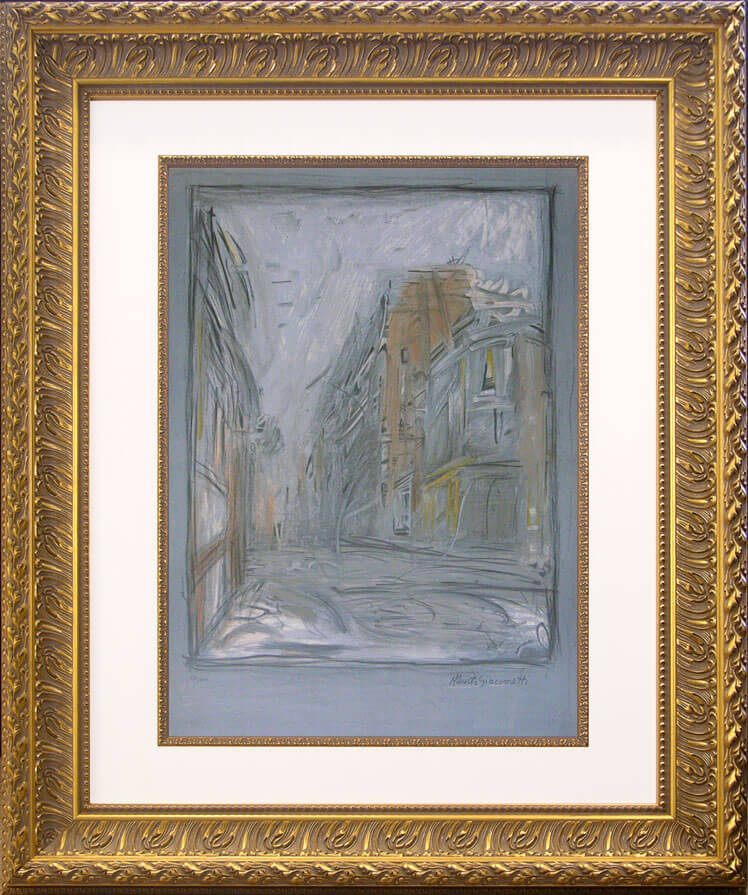
| Framed Size: | 44 1/2 in x 37 1/4 in (113.03 cm x 94.62 cm) |
| Signature: | This is hand-signed by Alberto Giacometti (1901 - 1966) in ink in the lower right |
| Condition: | Excellent |
| ID # | w-1113 |
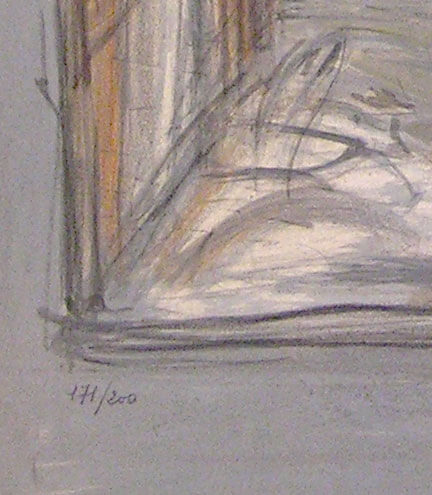
Created in 1954, this original Alberto Giacometti Rue d'Alesia color lithograph was published by Maeght, Paris and is Giacometti's only color print to have been created. Hand-signed in ink in the lower right by the Alberto Giacometti (1901 - 1966) , this work is numbered 171/200 in ink in the lower left from the avant-la-lettre edition. The work is documented as Lust 201 and was used for the Exposition Giacometti 1954 at the Galerie Maeght and listed in the Maeght archives as number 16. This is considered one of Giacometti's very rare prints, and the only one done in color.
Exhibiting the artist's skill in bringing life to inanimate objects, this work illustrates a street scene in a subtle and delicate manner. Comprised of muted grays, browns, blacks, and blues, the sensitivity in which the artist perceives his surroundings is evident in this work. The loose manner utilized by Giacometti is deceptive in the unstructured quality the viewer may perceive on first glance, but upon further inspection it is apparent that the buildings are proportionate, arranged with a strong sense of depth, space, and volume. The swirling of lines and shapes creates a sense of motion and activity, giving life to this quiet street without any inhabitants. Subtle in tonality, this work is full of active and expressive painterly gestures. Evoking a sense of spontaneity and intensity of execution, the narrow elongated structures in this image are reminiscent of the artist's figurative sculptures.
Catalogue Raisonné & COA:
Alberto Giacometti Rue d'Alesia is fully documented and referenced in (copies will be enclosed as added documentation with the invoices that I will enclose with the sale of the work) :
1) Lust, Herbert, Giacometti The Complete Graphics and 15 Drawings, 1970, listed as cat no 201 on pg 146.
2) Bonnefoy, Yves, Alberto Giacometti, 1991, the original painting is listed as cat no 475 on pg 485.
3) Lamarche-Vadel, Bernard, Alberto Giacometti, 1989, the original painting is listed as cat no 130 on pg 92.
4) Listed in the Maeght archives as Maeght 16.
About the Framing:
Conservation framed with archival materials and museum quality, Alberto Giacometti Rue d'Alesia is set in a robust Baroque-inspired frame. The bright tone of the framing accentuates the subtle colors in this piece. The sculptural details enhance and compliment the loose linear elements in this work. Completed with white, linen-wrapped mats and a matching gold inner fillet, this work is set behind an archival Plexiglas cover.
